
By the time a young player reaches the oldest age group at Brazilian Soccer School, which is for players aged 11 up to 18, the technical foundation is already in place. The touch, the close control, the comfort on the ball in tight spaces: all of it has been built patiently through the earlier stages of the programme. What comes next is a genuine shift in focus. Football training for teenagers is less about learning to control the ball and more about learning to read the game, sustain performance across a full match, and make good decisions under pressure. This is the stage where a technically capable child begins to grow into a well-rounded player.
This guide explains how effective teenage kids football development happens during our sessions and what parents and players can expect from training designed for this age.
Find out more about our sessions for teenagers
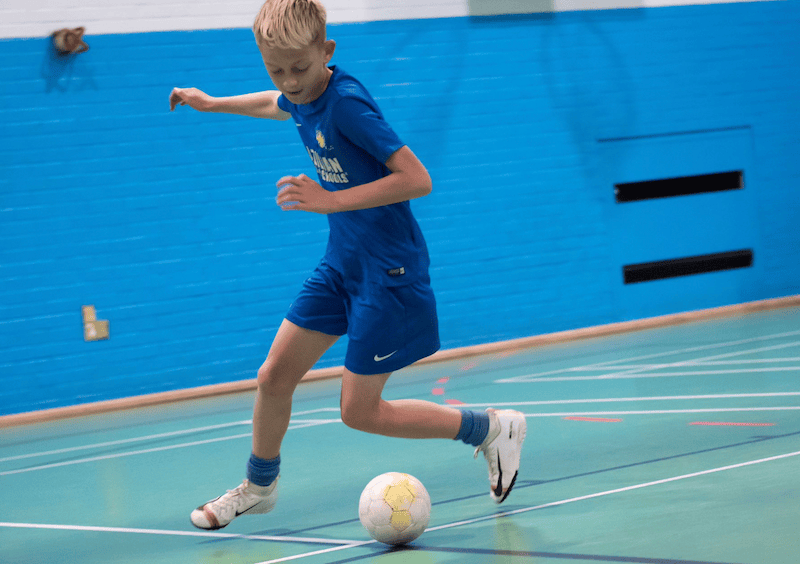
What Changes in Football Training for Teenagers Compared to Younger Age Groups?
The biggest change is that the emphasis moves from individual technique to tactical, physical and mental development. Earlier in a player’s journey, almost everything is built around ball mastery, because without a reliable technical base nothing else can follow. Once that base is secure, coaching can open up new chapters that a younger, less developed player simply would not be able to engage with fully.
At this stage the three developmental strands work together rather than in isolation. A teenager learns to think through a passage of play (tactical), builds the fitness to execute it repeatedly (physical), and develops the composure to hold their nerve when a match tightens (mental).
The table below sets out what each strand tends to cover at this level:
| Development strand: | What it focuses on: | Why it matters for teenagers: |
| Tactical | Positioning, decision-making, reading play, combinations, understanding all areas of the pitch | A more developed footballing intelligence lets players grasp the “why” behind movement, not just the “how” |
| Physical | General fitness, strength, stamina, recovery, and attention to diet | A changing physical profile means conditioning and nutrition start to have a real effect on performance |
| Mental | Composure, concentration, resilience, and competitive focus | Older players can handle the psychological demands of competition and learn from setbacks constructively |
Crucially, none of the earlier work is set aside. All of the techniques introduced in the younger age groups continue to be reinforced, so a player is adding new layers rather than replacing old ones. That is what allows teenage football development to feel like a natural progression instead of a sudden jump.
Why Does Positional Versatility Matter for Teenage Players?
Positional versatility is when a player has the ability to play in multiple roles across the pitch. It matters because players who understand the whole pitch make better decisions wherever they end up playing. Rather than being locked into a single role too early, teenagers at this stage are encouraged to gain a full appreciation of the experiences that come with participating all over the field of play.
There is a clear developmental logic to this. A player who has defended learns what forwards find difficult to play against. A player who has operated in midfield understands the passing angles that make a defender’s life easier or harder. When a young footballer has genuinely experienced the game from multiple positions, their tactical awareness deepens in a way that specialising too soon can prevent. It also keeps options open: many players do not settle into their strongest position until later, and a versatile foundation gives them room to find it. Much of that understanding is developed through small-sided games, where players experience different roles at close quarters, and it is these formats that shape the team play explored next.
This breadth is one of the quieter strengths of good youth football coaching. It resists the temptation to pigeonhole a talented child into one job on the pitch, and instead builds the kind of well-rounded understanding that serves a player for years.
And, if the Premier League comes a-calling, it can lead to your teenager being the perfect versatile player for their manager.
How Do Small-Sided Games Build Match Intelligence?
Small-sided games build match intelligence by giving players far more touches, decisions and repetitions than a full-sized game ever could. This will boost their confidence as a player.
At Brazilian Soccer Schools, team play is introduced through a range of formats, playing in various combinations from 1v1 all the way up to 11v11.
Each format teaches something different, and moving between them is deliberate. A 1 v 1 forces a player to solve an immediate individual problem: beat your opponent, or stop them beating you. As the numbers grow, so does the complexity of the picture a player has to read.
| Game format: | What it primarily develops: |
| 1 v 1 | Individual duels, close control, confidence in taking players on |
| Small-sided (for example 3 v 3 to 5 v 5) | Combinations, quick decisions, support play, frequent involvement |
| Larger-sided and 11 v 11 | Team shape, positional discipline, reading the full pitch, game management |
The value of starting small and scaling up is that players carry the sharp decision-making habits of tight games into the larger, more strategic ones. By the time they reach 11v11, the individual and combination skills built in smaller games become the foundations of genuine team play techniques. This progression is a defining feature of well-structured football training for teenagers.
What Role Do Futebol de Salão and Conventional Football Play Together?
Futebol de Salão sharpens technique and quick thinking, while conventional gameplay applies those qualities to the full eleven-a-side game. At this stage of the programme, practice deliberately uses elements of both.
Futebol de Salão, the Brazilian small-sided game played with a low-bounce ball, has long been credited with developing the close control and rapid decision-making associated with Brazilian football. Because the ball demands precise touches and the space is tight, players are constantly problem-solving at speed. Conventional football then provides the larger canvas on which those refined skills are expressed, with the space, physical demands and tactical structure of the eleven-a-side game.
Blending the two means teenagers keep honing the technical sharpness that Futebol de Salão is known for, whilst learning to translate it into the conventional format many of them will go on to play competitively. For older players with the maturity to appreciate both, this combination is one of the most effective ways to develop a complete footballer.
How Does Competition Sharpen Teenage Footballers?
Competition sharpens players by adding consequences to their decisions, which is exactly what accelerates learning at this age. As players reach the oldest age group, training focuses more on competition, drawing on elements of both Futebol de Salão and conventional gameplay in practice.
There is a developmental reason competition is introduced more prominently now rather than earlier. Younger children benefit from a low-pressure environment where the priority is enjoyment and mastering the ball. Teenagers, with their greater maturity and resilience, are ready to test their skills against real opposition and to handle the emotional side of winning and losing. That competitive edge reveals which decisions hold up under pressure and which need more work, and it builds the mental toughness that matters as the game gets more serious.
Handled well, competition and enjoyment are not in conflict. The aim is to give young players the thrill of a meaningful contest whilst keeping the environment positive, so that the drive to compete grows alongside a lasting love of the game.
What Should Parents Expect From Football Training for Teenagers?
Parents can expect a stage of the programme that deliberately broadens a young player’s game rather than simply drilling more of the same. The technical work of the earlier years does not disappear, but it is now joined by tactical understanding, physical development, mental resilience, positional variety and genuine competition. Taken together, these strands are designed to turn a child with the technical skills into a well-rounded footballer who understands the game from every angle.
For a teenager who has grown up through the programme, this final stage should feel like the natural continuation of everything they have already built, and the point at which a fully-formed player really begins to take shape.
Frequently Asked Questions
What age group is football training for teenagers aimed at?
At Brazilian Soccer School the oldest group is for players aged 11 up to 18. This spans the full teenage years, which is the stage where training broadens from technical foundations into tactical, physical and mental development.
Do teenage players train in a fixed position?
No. Players are encouraged to experience the whole pitch rather than being fixed in a single role. Playing in different areas builds a fuller understanding of the game and keeps a young player’s options open as they mature.
What is Futebol de Salão?
Futebol de Salão is the Brazilian version of futsal. The term “futsal” originates from the Portuguese “futebol de salão” and from the Spanish “fútbol sala” or “fútbol de salón”. They are all translatable as “indoor football”.
Futebol de Salão is a variant of association football played between two teams of five players. It is played on a pitch that is the size of a basketball court with a smaller, size 2 football which is heavier (465g) and has virtually no bounce (10%).
What size footballs do teenagers use in training?
Training uses FDS footballs alongside conventional Size 4 and Size 5 balls. The FDS ball keeps the focus on control and accuracy, while the larger balls prepare players for the standard game played at older age levels.
Is prior experience needed to join at this age?
No, teenagers can join without any prior experience. Our sessions are designed to support all of the children who come to them.
Building Complete Players Through Football Training for Teenagers
Everything at this stage is designed to build on a foundation that is already in place. With the technical basics secured in the earlier years, the oldest age group turns its attention to tactical understanding, physical conditioning and mental resilience, the three strands that separate a skilful child from a complete footballer.
Players broaden their game by experiencing every position, sharpen their decision-making through formats that scale from 1v1 up to 11v11, and blend the close control of Futebol de Salão with the demands of conventional play. Strengthening general fitness and diet supports the effort, and a greater focus on competition puts it all to the test. The result is a stage of football training for teenagers that feels less like a new programme and more like the moment a young player’s earlier work finally comes together.
And while many players will have grown up through the earlier stages of the programme, prior experience is not a requirement, so a teenager can join and begin their development here even if they have never played before.